

Turns out, it wasn’t just in the movies.
Pirate articles, or articles of agreement, were a code of conduct for governing ships of pirates, notably between the 17th and 18th centuries, during the so-called “Golden Age of Piracy”. The typical pirate crew was an unorthodox mixture of former sailors, escaped convicts, disillusioned men, and possibly former or escaped slaves, among others, looking for wealth at any cost; once aboard a seafaring vessel, the group would draw-up their own ship- and crew-specific code (or articles)…
You must log in or register to comment.
Let’s not get too romantic about pirates. In the Caribbean, the most lucrative goods that ships carried were, in fact, not goods. They were people.
Every ship used a different code that the crew voted and agreed upon jointly. The code determined what benefits were given to a pirate that was maimed or disabled during the taking of a prize, the share he gained from a prize (a taken vessel), and the rights of the crew during the election of a new captain.
When it comes to dividing shares of a prize, among them were ‘rights’ of the crew to take slaves instead of money or goods. At least, on the ship of Henry Morgan.
III. A standard compensation is provided for maimed and mutilated buccaneers. "Thus they order for the loss of a right arm six hundred pieces of eight, or six slaves; for the loss of a left arm five hundred pieces of eight, or five slaves; for a right leg five hundred pieces of eight, or five slaves; for the left leg four hundred pieces of eight, or four slaves; for an eye one hundred pieces of eight, or one slave; for a finger of the hand the same reward as for the eye.
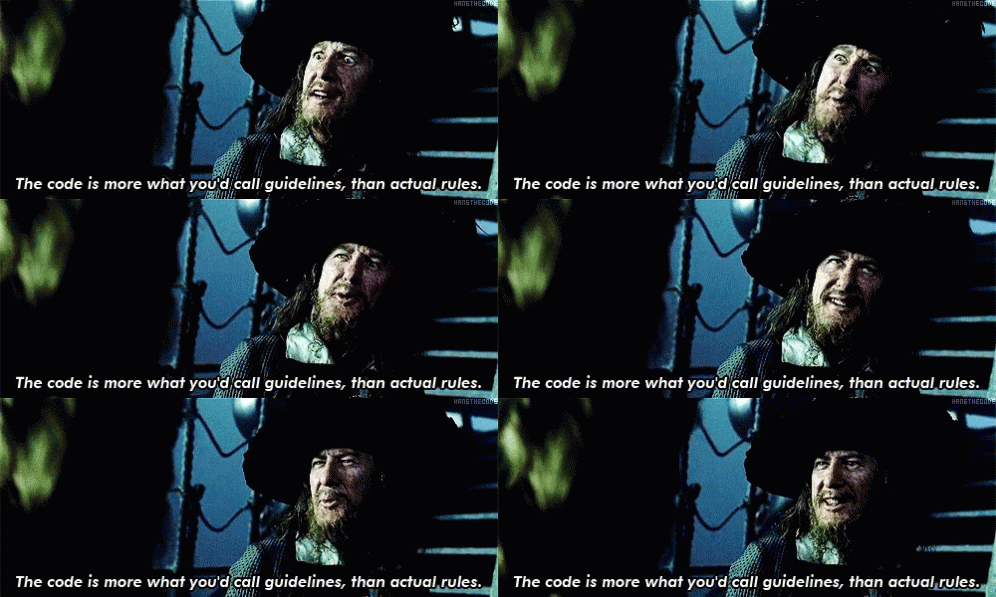
I’m no expert, but my sense from what I’ve read is that ‘the code’ could be relatively-strictly followed in some circumstances, and in others, followed or honored very little at all. Or could simply vary a lot in the rules.
Also, like all such rules, they could sometimes be adhered to in complete self-interest by various leaders or factions, and at other times, brushed off as ‘unrealistic’ (etc) by the very same groups. So a lot of it came down to the particular personnel who happened to be on a ship, I think?
Barbossa said it best.
Sounds like workplace politics havent changed very much in 400 years
In the sub-arctic tundra, there exists a feisty little rodent that understands.