I think you can have combat focused stories as long as your combat mechanics are lightweight and fast.
When I switched out my Shadowrun game to The Sprawl, and then eventually a homebrew, I actually got less afraid of letting combat happen because I knew it wouldn’t eat up ninety percent of the session. By volume of time spent, combat became much less of each session, and yet conversely combat could happen at any time and every scene could feel like a fight might break out because there was no sigh “Roll for initiative…”
With fast, lightweight combat mechanics (especially ones that do not have an initiative system) you get to weave violence into the substance of your story constantly, without the system taking place of the storytelling.
That’s not to say that less combat focused games are a bad thing. The other big change I found was that it was also much easier to run sessions where no fighting occurred, because I didn’t have to figure out how to fill the several hours that should have been taken up by a fight, and the players never felt like there was a difference between fighting and talking and everything else. It all just became part of the broader texture of the story, so a session with no fighting didn’t feel weird or out of place.
I tend to find an 2:1 or 3:1 combat/non-combat gives people a good mix of the action/adventure elements and the high drama. Combat just tends to take longer than drama, so even when you try to minimize it, you can often find yourself in a time-suck.
I also tend to feel that any “withering encounter” should resolve as soon as the players are more-or-less assured of victory (like, 2-3 turns, unless things go disastrously wrong for the players). Big center-piece boss battles can take longer, but need some kind of high drama element (exploding volcano, NPC dangling off a cliff, evil wizard powering up a death ray, etc) that (a) gives players a puzzle or drama point to resolve and (b) gives someone an opportunity to do something passionate or wacky (swinging in on a chandelier, flinging themselves on a hand grenade, asking their beau to marry them in the middle of a sword fight).
Any encounter that’s just “roll the dice, pass the turn” is a waste of everyone’s time, IMHO.
Every player is different, every DM is different. Thats why communication at the top is important, if you want to get heavily in to character and roleplay a detective mystery in the tavern, let your DM know that.

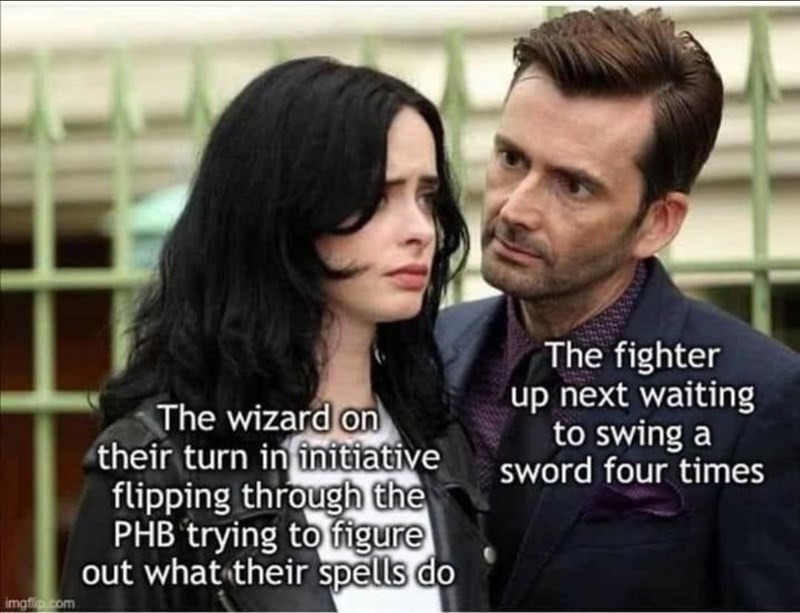
this is why ttrpgs should not be so combat-focused.
Depends on the players. Some want to play pretend. Some want to play XCOM with dice.
I’m the asshole that likes a fine, precariously balanced mix of PORQUE NO LOS DOS
I would 100% play a decent XCOM tabletop rpg
themoken@startrek.website Some want to play XCOM without dice, and get really pissy when the dice say “no”.
I think you can have combat focused stories as long as your combat mechanics are lightweight and fast.
When I switched out my Shadowrun game to The Sprawl, and then eventually a homebrew, I actually got less afraid of letting combat happen because I knew it wouldn’t eat up ninety percent of the session. By volume of time spent, combat became much less of each session, and yet conversely combat could happen at any time and every scene could feel like a fight might break out because there was no sigh “Roll for initiative…”
With fast, lightweight combat mechanics (especially ones that do not have an initiative system) you get to weave violence into the substance of your story constantly, without the system taking place of the storytelling.
That’s not to say that less combat focused games are a bad thing. The other big change I found was that it was also much easier to run sessions where no fighting occurred, because I didn’t have to figure out how to fill the several hours that should have been taken up by a fight, and the players never felt like there was a difference between fighting and talking and everything else. It all just became part of the broader texture of the story, so a session with no fighting didn’t feel weird or out of place.
hm.
i do own the sprawl, and i don’t remember why now but that book made me uninterested in pbta as a whole. maybe i’ll go back to it.
combat’s fine if you need actual strategy, like in pathfinder
I tend to find an 2:1 or 3:1 combat/non-combat gives people a good mix of the action/adventure elements and the high drama. Combat just tends to take longer than drama, so even when you try to minimize it, you can often find yourself in a time-suck.
I also tend to feel that any “withering encounter” should resolve as soon as the players are more-or-less assured of victory (like, 2-3 turns, unless things go disastrously wrong for the players). Big center-piece boss battles can take longer, but need some kind of high drama element (exploding volcano, NPC dangling off a cliff, evil wizard powering up a death ray, etc) that (a) gives players a puzzle or drama point to resolve and (b) gives someone an opportunity to do something passionate or wacky (swinging in on a chandelier, flinging themselves on a hand grenade, asking their beau to marry them in the middle of a sword fight).
Any encounter that’s just “roll the dice, pass the turn” is a waste of everyone’s time, IMHO.
Every player is different, every DM is different. Thats why communication at the top is important, if you want to get heavily in to character and roleplay a detective mystery in the tavern, let your DM know that.