For Legal Purposes: No, officer, I do not pirate, just curious… 👀 🤫
Edit: Yes I’m in the US, but I’m also curious about other countries laws, so please share. I’m curious to know the difference.
“I am training my AI”
“Net worth below One Billion, Die Pleb”
💀💥🔫👮♂️🚔
There are separate criminal and civil offenses when it comes to copyright infringement, assuming USA. Very generally, under criminal law, it is an offense to distribute copyrighted material without the right or license to do so. Note the word “distribute”, meaning that the crime relates to the act of copying and sharing the work, and usually does not include the receiving of such a work.
That is to say, it’s generally understood that mere possession of a copyrighted work is not sufficient to prove that it was in your possession for the purpose of later distribution. A criminal pprosecution would have to show that you did, in fact, infringe the copyright by distributing a copy to someone or somewhere else.
Separately, civil penalties can be sought by the copyright owner, against someone found either distributing their work, or possessing the work without a license. In this case, the copyright owner has to do the legwork to identify offenders, and then would file a civil lawsuit against them. The government is uninvolved with this, except to the extent that the court is a branch of the federal government. The penalty would be money damage, and while a judgement could be quite large – due to the insanity of minimum damages, courtesy of the DMCA – there is no prospect of jail time here.
So as an example, buying a bootleg DVD for $2 and keeping it in your house would not accrue criminal liability, although if police were searching your house – which they can only do with a warrant, or your consent – they could rip-off the copyright owner and you could late receive a civil lawsuit.
Likewise, downloading media using Megaupload, usually also doesn’t meet the “distribution” requirement in criminal law, but still opens the door to civil liability if the copyright owner discovers it. However, something like BitTorrent which uploads to other peers, that would meet the distribution requirement.
To that end, if officers searching your home – make sure to say that you don’t consent to any searches – find a running BitTorrent server and it’s actively sharing copyrighted media, that’s criminal and civil liability. But if they only find the media but can’t find evidence of actual uploading/distributing, and can’t get evidence from the ISP or anyone else, then the criminal case would be non-existent.
If the government raided your house
…then they have other things to do (and you have worse problems) than watching your vidoes or discuss copyright questions.
but I’m also curious about other countries laws
Here in Germany, it is quite possible that you get raided for copyright claims. It has happened. But that means that a suspicion must have existed before. And your chances of getting shot or brutally beaten up during the raid are lower.
I knew a guy who had a pirated copy of Office, and was doing a presentation for a law enforcement branch of government where the crack screen popped up when he launched his PowerPoint presentation.
After the presentation he was told to go and buy a legitimate license and show them proof he’d done so.
I hope he sent them a forged receipt.
Made in pirated Photoshop (even though he uses GIMP).
In the US, virtually no one has been legally prosecuted for consumer level piracy since around 2010. The only exception is a small group of copyright trolls that focus on porn videos. The government was never the one doing it; if the government raided your house and found evidence that you illegally torrented .mkv files, they wouldn’t care or do anything with that information.
That said you should still use a VPN, because industry groups are now completely focused on getting ISPs to send intimidating letters to people and eventually shutting off their internet. If you use a VPN and bind your torrent client to it, you are entirely safe from all consequences that actually happen.
Thank you for reminding me about the thermite I need to build into my NAS.
It doesnt matter if you just store them for private use, it only becomes a crime if you share them, if someone else has the same file (hash) then that means you shared it, otherwise no way to prove anything illegal happened
if you download a file (not via BitTorrent), your downloaded file will have the same hash as the person who shared it with you, but that doesn’t mean you were the sender.
Good to know. Doesn’t change much
I’m not a lawyer and haven’t had such a situation before, but isn’t the burden of proof supposed to be on the accuser, not the accused? They’re the ones who need to prove the files have been illegally obtained, not the other way around.
consumer level copyright infringement is generally a civil matter, not a criminal one. you’d have to be doing something like selling bootleg dvds for it to turn into a criminal issue.
I’m my case, I either have proof that I bought them in the form of the original DVD, or the movies are in the public domain, or they are digital copies of home movies.
How are they gonna break my encryption?
With a $5 wrench and a relevant XKCD.
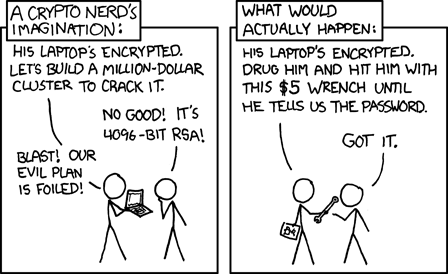
With inflation that wrench is likely $12 now.
It doesn’t matter. They will apply the criminal label regardless.
Source: Trust me bro
I’ve only ever seen people prosecuted where the copyright holder was tracking downloads on specific sites and requested the prosecution. So, the proof would be where you downloaded the media from, not on the media itself.
deleted by creator