I suppose it would be mostly practical skills, cooking, fixing things. Usually had to be done by people themselves.
Maybe also mental things like navigating (with or without paper map) and remembering their daily and weekly agendas.
What other things would be a big difference with the people today?
Morse code.
Definitely more than 50 years ago, but this little piece of Americana is interesting
Families often had small nail-manufacturing setups in their homes; during bad weather and at night, the entire family might work at making nails for their own use and for barter. Thomas Jefferson wrote in a letter: “In our private pursuits it is a great advantage that every honest employment is deemed honorable. I am myself a nail maker.”
Cursive writing
Idling away the time, being bored.
Doing nothing. That might be the biggest loss in the last decades.
There is just this overtone of restlessness and tension that didn’t seem to be present prior.Also connection with your local community. 50 years ago, it was basically a given. It was part of life.
Now, not so much.
Writing thank you cards and letters.
Reading cursive writing (especially from the 18th century or earlier).
Navigating a paper map.
You want to drive to a suburb of a big city. You have an address. The internet doesn’t exist.
How do you get there? Well. You use a map. Almost every glove box would have a local and state map, if not a full map book like a Thomas brothers.
Even more scarce is the ability to navigate a city by simply understanding it’s road system. Give me an address in my home city (a labyrinthine nightmare to visitors) and I can just drive there without looking at a map. It’s practically a party trick now that I can tell where people live by just hearing their address. Which sounds absurd until you realize they no one ever needs to do that anymore.
Road networks in most cities in my country are like someone just dropped a pot of spaghetti. He oldest urban areas here are at most 160 years old too, so it’s not like we can blame the Romans.
Me living in a city with Roman walls:
Are you saying I can blame the Romans for not knowing an address? Cool.Actually, it’s a rather small city. It’s hard to get lost when you can easily walk from one end to the other.
Actually a much better way was to use a street directory if you know your way around the town even a bit.
Better even, and how we actually did it was giving instructions. “200m after the large tree by the field, drive on for about 400m, there’s 2 junctions before and mines the third one.”
But I also know orienteering ofc as a Finn
Swede here, how would using a street directory help you navigate without a map?
Sure, I know that at least here in Stockholm and it’s suburbs that when a new area is being developed, they name the streets after a similar theme.
But knowing that Sommarvägen in Täby is located within the district of Hägernäs doesn’t get you very far.
You look up a street name. That entry tells you which street it begins from. If you don’t know that, then you look up one further. And repeat until you get to such a main road you’d know it even after looking at a map.
So basically you’d look up the street and then browse back and after you’d have a sort of gps like instructions. “main road until you see X street, then turn there, then drive until you see Y road” etc.
I had several in the car I drove, for all the nearby cities/towns. Many in same covers. So it’d cover the main city and outlying towns. Never had to use a map. (Although again, I can if needed.)
I wonder if it took quite a bit longer for people to reach their destination. Because not everyone would be as good at reading maps (compared to simply following gps instructions) Maybe that made it more common for people to arrive at different times. or plan longer trips because the driving would take up a bigger part of it.
Also, when driving alone, I can’t imagine holding your map. So you would still have to stop from time to time for long trips. And actually memorize the big lines of how to get to your destination.
Going along with reading a map most people don’t know how roads and exits are numbered. It’s not a random jumble. This makes reading a map and just knowing what direction you’re traveling in general much easier. This is for the US.
Interstates
1 or 2 Digits: Main routes. North-South routes have odd numbers, increasing from west to east (e.g., I-5 to I-95). East-West routes have even numbers, increasing from south to north (e.g., I-10 to I-90).
3 Digits (Even First Number): A loop or beltway that connects to the main interstate at both ends.
3 Digits (Odd First Number): A spur route that connects to the main interstate at only one end.
Exit numbers
They mirror the mile markers which show up on maps. Numbers increase from south to north or west to east. So you could basically make a ‘cheat sheet’ of your exit numbers. Then while driving you know how far till your next exit.
I’ve seen this not be true on occasion but it should be mostly true. If the exit sign is on the right of the road sign then the exit is to the right. If it’s on the left then it exits to the left.
All knowledge that I feel got lost to time for the most part. They should teach it in drivers ed but I don’t think they do.
I wonder if it took quite a bit longer for people to reach their destination. Because not everyone would be as good at reading maps (compared to simply following gps instructions) Maybe that made it more common for people to arrive at different times. or plan longer trips because the driving would take up a bigger part of it.
Oh it absolutely did. You would regularly have to stop (often after a turn or if you felt like you missed one) and reconsult the map. You just accounted for that additional time. Longer trips are often less of an issue, because its usually, you get to a big main highway and its cruise most of the rest of the way.
And plenty of times, you might get lost/ not be able to find yourself on the map. You’d have to pull over and ask for help/ directions. You might write the directions down on a piece of paper, but that doesn’t do you much good if you missed a turn and didn’t know it.
Depends on the area and how familiar it is and how hostile it is to navigation. I can beat the Google maps time 9 out if 10 times in Seattle because Google sends you through some seriously dumb intersections.
In Minneapolis, Google maps almost always tells me to leave the parking lot from work, go down the road, and turn left onto a highway during rush hour. No lights.
The way I actually go is to turn 1 block “early” and wait at the stoplight.
Sure, in theory it would be faster to take Google’s way if there’s no traffic, but again – this is when I’m leaving work!
I still carry a state map in my truck
That reminds me that I never moved the map from old car to the
newcurrent one.
I was so obsessed with NYC subway maps lol (circa 2010)
When I was a kid, I used to just draw my interpretation of the subway routes + streets and like make my own “map”
Learning how to do things yourself because you had to. Now people have an app for getting somone out to hang a picture
Remembering phone numbers.
0118999881990119725
3That’s just because we don’t dial them anymore, fuck, we barely make phone calls anymore.
i got you.
281-330-8004
867-5309!
Using a card catalog at the library to look up books.
I worked in a private library that still had it’s card catalogue up until 2005. People were always ripping out the cards (there was something like a metal knitting needle that passed through a punched hole in each card to stop idiots from destroying the catalogue, so the gobshites ripped them out instead).
The early digital catalogues weren’t great so the old card system persisted.
I never learned this. I always just browsed around and read what caught my attention. Maybe if I was doing research, I would have had to learn it.
It was a fairly regular part of our public school education
Skill most people had:
- Sewing, at least basic sewing. Tailors were expensive, and if you just needed to shorten a pant leg, or fix a hole, you just sewed it. Nowadays mending clothes is almost pointless, given they’re basically made to get holes in them immediately.
- Speaking quickly to avoid collect call fees. People would call home from a hospital phone, which would charge the receiver’s bill if they accepted the call. The phone would ask for your name, and you’d say your message quickly, which lead to your parents at home getting a call from “Baby’s a healthy boy” and then hanging up.
Difference: The whole world doesn’t smell like cigarette smoke anymore. Even when I was a kid in the early 00s, it still smelled of cigarettes basically everywhere.
So y’know. We can’t sew a patch on, or speed rap to avoid collect call fees, but at least drunk driving is illegal, and we have seatbelts
State your name:
Bob, the Adababyeetza boy.
Memorizing phone numbers
We didn’t memorise numbers! We just remembered them after having to manually dial them a hundred times.
Why wife’s phone number is ‘babe’ and ill die on that hill.
I feel like it’s still important to remember the numbers of some important contacts, so you can actually call them using somebody elses phone if yours dies or breaks. But I suppose not many people would bother
Lol, not only do I memorize phone numbers of family members, I did my parents taxes so often, I can memorize the social security numbers of all my household members and all their birthdates.
Also I still remember addresses I used to live in.
Mmmm, interesting, can you list off that data along with your mother’s maiden name? It’s uh for a friend…
Sure it’s [data expunged] and [data expunged] and [Error: Security Clearence not found]
Lol, sorry, you seem to lack the credentials. It’s “need-to-know basis” only. :P
Seriously tho, my family is so like… idk I guess “emmeshed”? Like everything is so entangled.
Like my mom literally use my brother’s legal identity to take out loans… and also some assets are put under his name
Also like mom used to not even have a screen lock on the phone until someone robbed her so now there’a a screen lock.
And like I have access to their phones… and sometimes messed with settings and mom got mad at me.
I don’t even have any legal papers in my physical posession except like my state ID, cuz my mom wanted to “keep it safe” for me…
To be fair: I held on to my first US passport as a teen I kinda damaged it lol (got it just to make sure my Citizenship status is properly documented in the legal system), never even had a chance to actually use it since parents were so busy all the time.
If there is ever a family issue… oh shit we all know each other’s info, we could theoretically do so much damage to each other like a family “civil war”.
Basic shoe maintenance
I’d like to learn this. I used to wear shoes for more than 5 years in the past, but nowadays they don’t seem to last even a year. Maybe I should search for better brands. But replacing the sole should be inexpensive and that’s usually the only part that really wears down much.
Most shoes aren’t really built to be resoled these days, they’re out there and if they can be they usually make it a selling point of that shoe, they’re usually a good bit pricier than other comparable shoes as well, probably gonna be about $250usd at the low end
Coincidentally I actually just sent my hiking boots out to be resoled. I have a pair of Danners, they cost probably around $450 new, and I’m getting their full recrafting service, so new heel counter, shank, resole, goretex lining, and if my shoe had any broken hardware that’d get replaced too, cost I think $260. Just a simple resole would be cheaper of course, and if you have a decent local cobbler they could probably beat that price.
I’ve had them about 4 years, and at this point the sole is pretty well-worn-out but the uppers are still in pretty good shape. They’ve been worn pretty close to daily, and have some hard miles on them.
I definitely feel that I’ve gotten my money’s worth, before these I probably got new boots every 2 years or so and usually spent about $200 on a pair, so if these last me another 4 years (and I don’t have any reason to think they won’t, but there’s no guarantee what misadventures my boots might go through in the next 4 years) I’ll have even come out a bit ahead on them vs buying cheaper boots.
These are hiking boots, so I’m not exactly keeping them mirror-polished or anything, so care is pretty minimal, clean them with saddle soap once in a while, wipe them down with mink oil or whatever your preferred leather conditioner/waterproofing stuff is a couple times a year (I generally try to do at least twice a year, maybe a bit more frequently if they’re getting a lot of hard use- getting really dirty, worn in the winter or near the ocean where they may be getting salty, etc.)
Also not shilling specifically for Danners, I’ve been very happy with them so far, but there’s plenty of other brands out there that are as good or better, and of course everyone has their personal preference. My next pair may or may not be danners, I do have my eye on some boots from higher-end manufacturers if my budget allows.
If you knew how to drive, you most likely knew how to use a manual transmission.
This one depens on where you live, I suppose. In some european countries it’s still quite common to learn to drive with a manual.
deleted by creator
I still have a manual
Lots of semi truck drivers know how to drive a manual and semi truck driver is one of the most common occupations in the US. Everyone at my company’s location knows how even though we have an all automatic fleet.
You likely already know this but if anybody else reading is interested, this is because if you test for your commercial license in an automatic then you’re restricted to only automatics. The schools are still teaching manual, so it doesn’t make any sense to learn that then test in an automatic and get that restriction.
Writing in cursive
This is such a good thing. Whenever I look at cursive writing it’s indecipherable. It being included in school curriculums really feels like someone went “no I’m good at writing! Cursive writing is good! Children need to learn it, in fact.”
Do you mean that you can’t read it at all? It’s really close to lettering, it’s just got swoopies attached to most letters. There are only around 4 that you have to know how they’re different, but the rest are super similar.
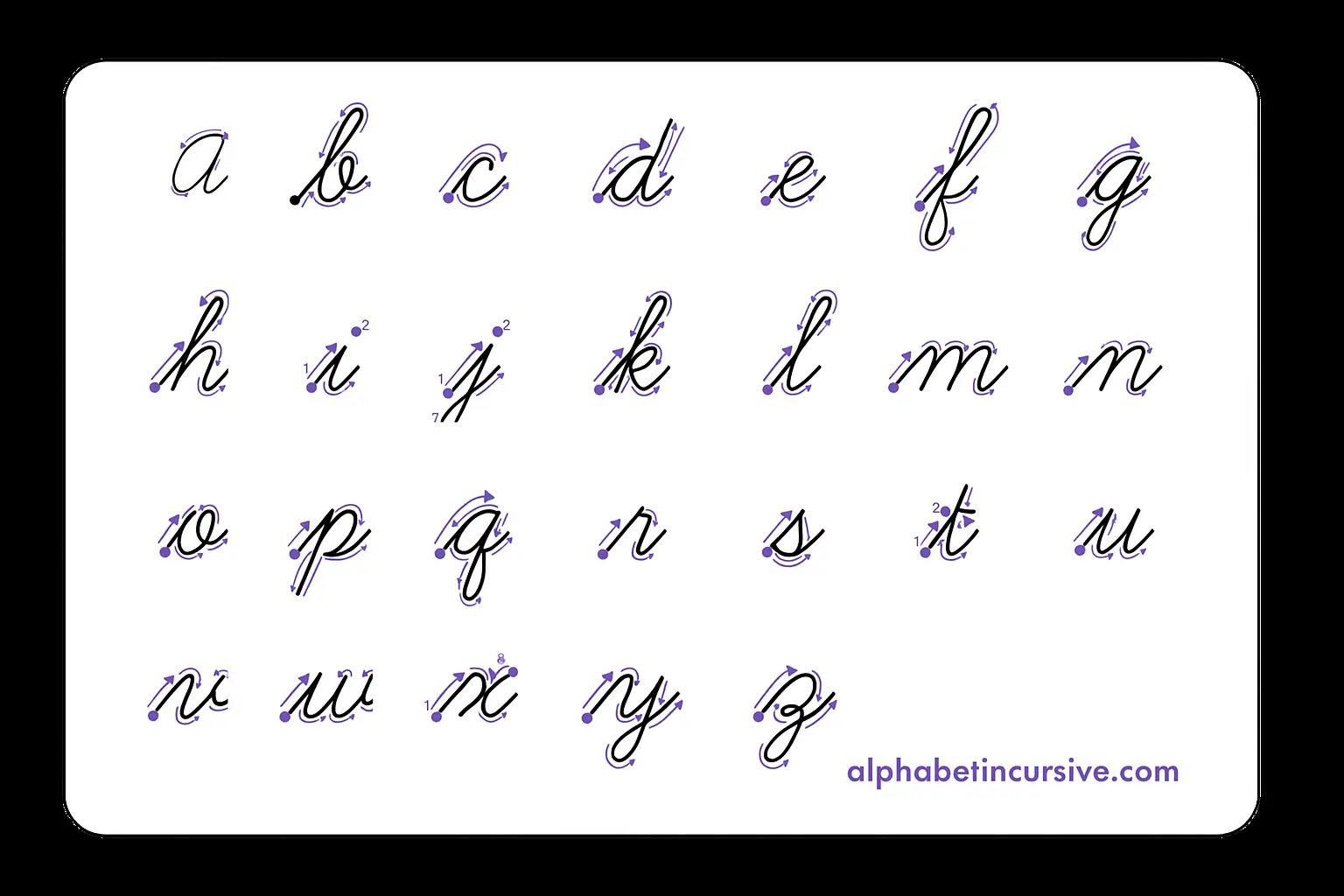
This is definitely dependent on the person writing. Some cursive is illegible, others is totally fine.
I mean, some non-cursive is totally illegible. My print is pretty bad, but my cursive is fine
That’s true. I learned cursive first, but never really properly. Then learned print instead. Now my writing is a mashup of cursive and print, with the same letter in a single sentence sometimes using different writing styles. Great!
I’ve tried to read 19 century cursive journals and other historical documents. It’s impossible, and I’m old enough to have learned it at school.
There’s a reason engineers and technical disciplines used block/print letters.
There’s a bunch of different systems that vary how close they are to standard print
At this point it’s actually kind of useful as a mild coded writing that excludes idiots.
My cursive is still excellent